
Omar Hilale affirms at the UN that Resolution 2797 ends the management logic and moves the dossier toward a final settlement

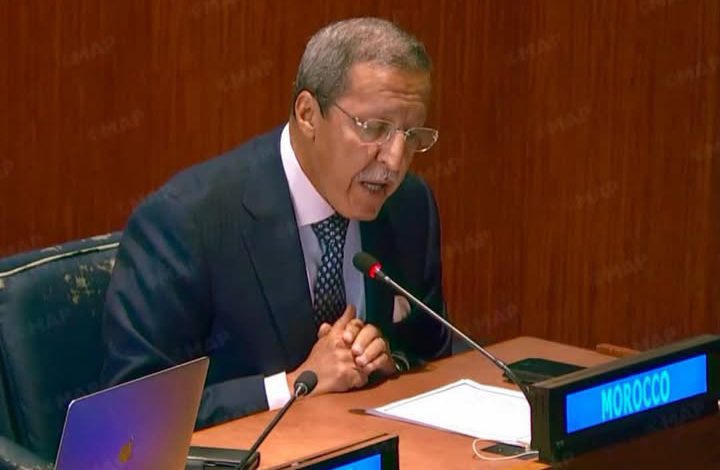
Security Council Resolution 2797 constitutes a “decisive turning point” in the UN’s handling of the Moroccan Sahara dossier, shifting from a logic of managing the issue to one of final settlement. This was affirmed by the Ambassador and Permanent Representative of Morocco to the UN, Omar Hilale, during his address on Tuesday in New York before the Fourth Committee of the UN General Assembly.
Mr. Hilale explained that this resolution, which has been welcomed by all parties, represents an “irreversible turning point compared to all previous Security Council resolutions.” The Moroccan diplomat pointed out that the UN document enshrines the Moroccan autonomy initiative as the sole basis for settling this regional conflict, placing it at the heart of the political negotiation process.
In the same context, the Moroccan official highlighted that the resolution has, for the first time, “integrated the status of autonomy within the framework of Moroccan sovereignty,” adding that the UN text reaffirms the responsibility of the four parties—Morocco, Algeria, Mauritania, and the “Polisario”—calling on them to engage in good faith and without preconditions in the search for a final political solution.
Resolution 2797 facilitated direct talks between the four parties during three meetings held in Washington and Madrid. These talks allowed Morocco to present the advanced autonomy status, detailing the competencies of executive, legislative, and judicial bodies—a proposal that reconciles political realism, democratic governance, and the aspirations of the population.
Ambassador Hilale called on each party to assume its historical responsibility in implementing this resolution, stressing the need to proceed with discussions without preconditions, translate good faith into action, and restore the ceasefire.
The human dimension and the suffering in the Tindouf camps
Furthermore, Ambassador Hilale noted that Resolution 2797 and the momentum of the negotiations carry, above all, a humanitarian promise. He expressed regret that the mere humanitarian management of this situation, which is the second-longest detention crisis in the world, cannot continue for another half-century.
He emphasized that Morocco calls for enabling the residents of the Tindouf camps to access sustainable solutions provided for by international law and the UNHCR doctrine, namely voluntary return, resettlement in a third country, or integration into the host country. He deemed any delay or condition “illegal in terms of human rights, politically immoral, and humanely unacceptable.”
Correcting concepts and refuting historical fallacies
While recalling historical fallacies and legal distortions, Ambassador Hilale was keen to correct several concepts. Regarding decolonization, he recalled that this file was definitively closed half a century ago with the return of the Sahara to its motherland through the Green March and the Madrid Agreement. Regarding the principle of self-determination, he clarified that UN doctrine is complemented by resolutions 1541 and 2625, which enshrine the inviolability of national and territorial unity.
Ambassador Hilale concluded that the optimism sparked by Resolution 2797 promises a final settlement of the regional conflict, carrying the ambition to revive the Maghreb Union and make the Southern Mediterranean, the Sahel, and the African Atlantic space more secure, stable, and prosperous.




💬 Share your opinion
We welcome constructive opinions and ask you to maintain politeness.
0 comments