
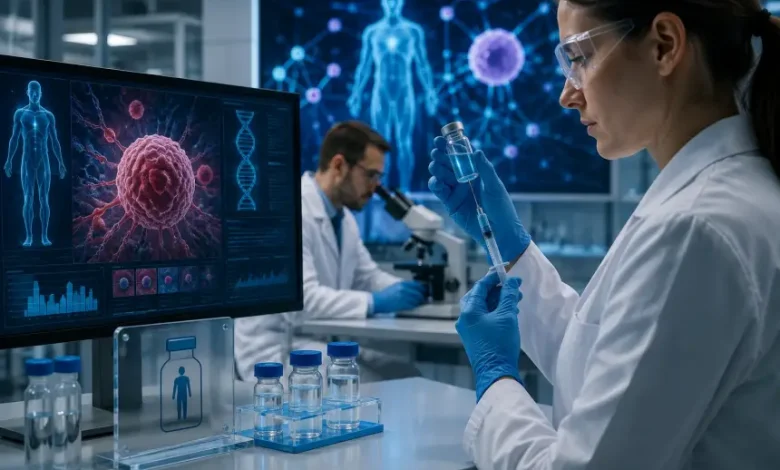
A new phase in the fight against tumors
Science has taken a decisive step toward making the dream of personalized cancer therapy a clinical reality. Moderna and Merck have announced promising results from a phase 3 clinical trial targeting melanoma, introducing a revolutionary concept based on tailoring treatment precisely to each patient’s genetic profile.
How does personalized vaccine technology work?
Unlike traditional vaccines, this treatment is not preventative; it is custom-made after the surgical removal of tumors. The technique aims to train the immune system to recognize, track, and destroy residual cancer cells before they cause a relapse or spread to vital organs.
Details of the ambitious clinical trial
The “INTerpath-001” trial involved more than 1,137 patients with advanced melanoma. The results showed a significant improvement in recurrence-free survival, marking the first phase 3 success based on messenger RNA (mRNA) technology.
Manufacturing mechanism: extreme precision
The process involves analyzing the genetic sequence of the excised tumor to identify unique mutations. Using advanced algorithms, a vaccine is created that carries instructions for producing “neoantigens.” Once injected, the body’s T-cells learn to target these proteins, while the drug “Keytruda” acts as a coordinator, removing the obstacles the cancer places to disable the immune system.
Why don’t we have one vaccine for all types of cancer?
Experts explain that cancer is not a single disease. Melanoma is ideal for these trials because of its high mutation count. Despite challenges with tumors that have fewer mutations, research is ongoing to expand this technology to lung, kidney, and bladder cancers, opening a bright new chapter in the history of precision medicine.





💬 Share your opinion
We welcome constructive opinions and ask you to maintain politeness.
0 comments