
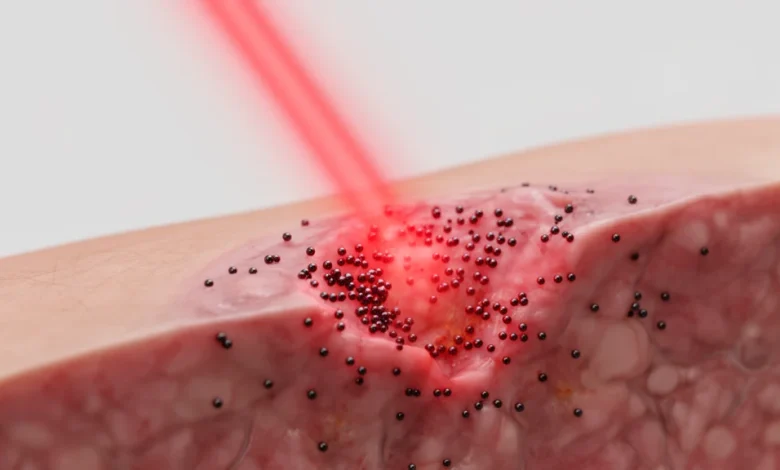
A research team from Nagoya University in Japan has revealed the development of a promising therapeutic technique that integrates “nanotechnology” and phototherapy, aiming to target cancer cells that usually manage to escape conventional targeted treatments. This study, published in the journal “Journal of Nanobiotechnology”, seeks to provide radical solutions that reduce the risk of malignant tumors recurring after treatment periods end.
Dual mechanism of “iron and light” in confronting cancer
The innovative technique relies on the use of iron oxide nanoparticles, with a diameter not exceeding 20 nanometers, carefully combined with antibodies linked to a chemical dye sensitive to near-infrared light. When light is shone on the affected area, these particles generate high localized heat that is transferred directly to the surrounding cancer cells.
The researchers explained that this process, which they termed the “photothermal bystander effect,” is characterized by its ability to destroy cells that lack the target proteins—cells that often survive conventional treatments and cause health relapses in the future. Moreover, the iron molecules offer the additional advantage of being able to track the path of the therapeutic agent inside the body and monitor its arrival at the tumors with high accuracy using Magnetic Resonance Imaging (MRI).
Encouraging laboratory results on animal models
According to the data contained in the study, laboratory experiments showed high efficacy that increases with repeated light exposure sessions. This is due to the treatment improving the permeability of blood vessels within the tumor, which facilitates the accumulation of larger amounts of the cancer-cell-killing nanoparticles.
The research team recorded remarkable results in animal trials, where the technology led to the complete disappearance of tumors in 4 out of 10 mice in one group, and 3 out of 6 mice in another group that suffered from complex tumors comprising diverse cell types. Preliminary safety tests also confirmed the absence of obvious toxic effects, as the animals maintained their normal weights without any detected damage to liver functions.
Technical challenges before transitioning to human trials
Despite this scientific breakthrough, the research team emphasizes that the technology is still in its early experimental stages and has not yet been tested on humans. Several technical challenges must be addressed, most notably the limited penetration of light into deep tissues of the human body, which may currently restrict its use to tumors close to the surface.
The scientific report also pointed to the necessity of conducting in-depth studies on the long-term effects of iron accumulation inside body organs and ensuring the safety of its long-term use. The researchers at Nagoya University aspire for these results to pave the way for expanding nanotechnology-based treatments to include different types of cancers, offering new hope to tumor patients in the future.




💬 Share your opinion
We welcome constructive opinions and ask you to maintain politeness.
0 comments